Cleanroom accessories: Cleanroom mop

Contents

The requirements for cleanrooms are constantly increasing, so the requirements for hygiene and the material of cleanroom mops should also be a high priority. Why? Floors represent the largest surface area in a cleanroom (compared to the total surface area). However, as these do not come into contact with the product, cleaning them is usually considered to be of secondary importance.

Many particles that are carried into the cleanroom air by the operator through movement and turbulence, for example, ultimately end up on the floor or can return to the ambient air through movement.

A mop that can pick up as many particles as possible ensures that this area is not an unconscious source of contamination. Similar to cleanroom wipes, mops cannot be assigned to an air cleanliness class. This is why the designation "ISO 7 suitable", for example, is misleading. For this reason, cleanroom and hygiene managers should consider the following factors.
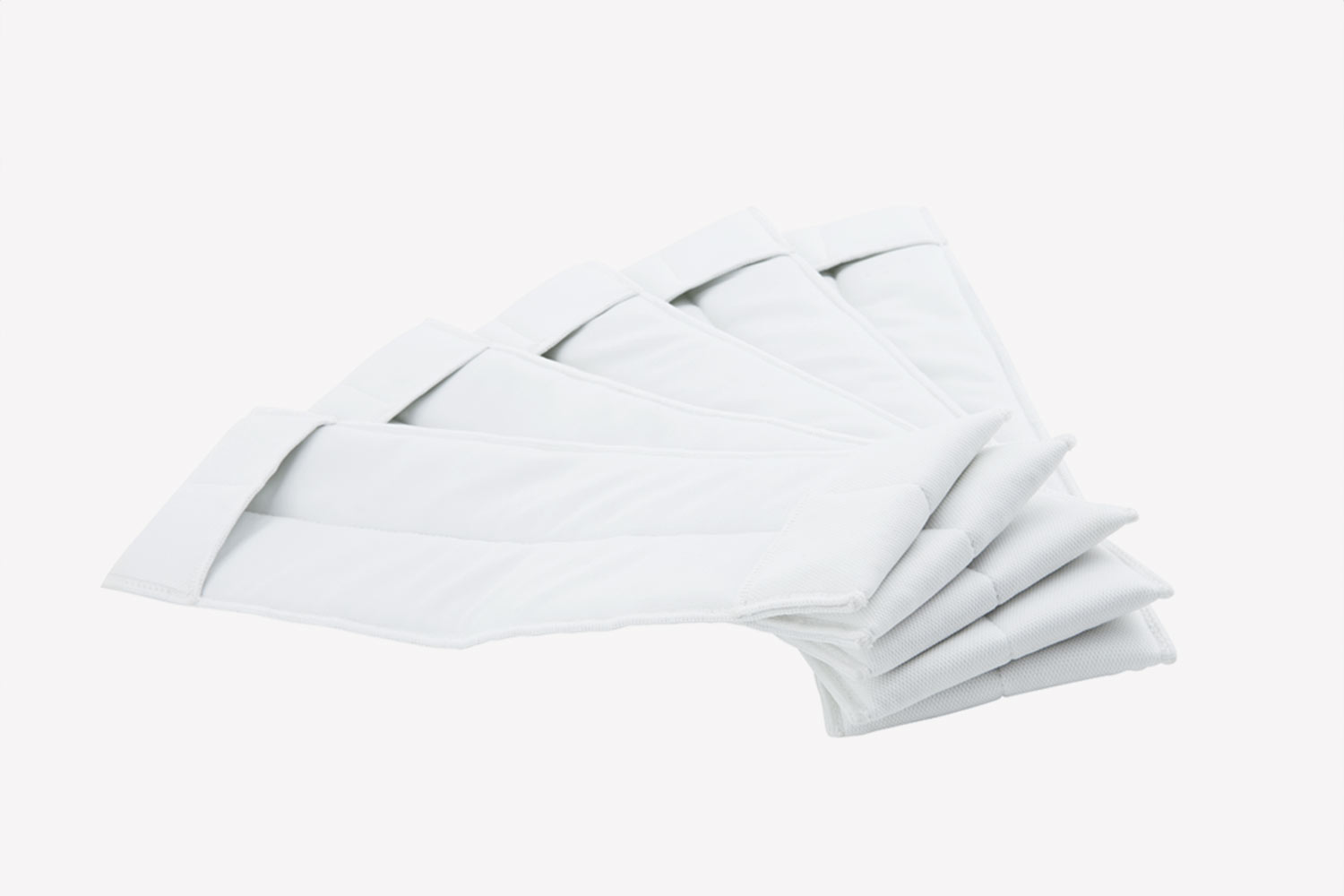
Cleanroom mops can be categorized as follows

  • Disposable or reusable mops
  • Composition of the material
  • Shape and processing

Disposable cleanroom mops are also available in the following versions

  • Dry mops
  • Pre-moistened mops or soaked mops
  • Sterile mops
comprei cleanroom mop PurMop-EC40

Disposable or reusable cleanroom mop

Both versions offer fundamental advantages and disadvantages. It is not possible to give a blanket answer as to whether a disposable or reusable system should be used; it depends on factors that need to be evaluated internally. The knowledge gained from this flows into the creation of a cleaning and disinfection concept. comprei training can develop a coherent concept in the form of a workshop in cooperation with the customer. The most important advantages and disadvantages at a glance.

Material quality

  • Disposable mop (Ready to Use) (+) Advantages: Textiles with high fiber quality, large fiber surface and large capacity to absorb, store and release moisture and cleaning agents.
  • Reusable mop (+) Advantages as with disposable mops: Textiles with high fiber quality, large fiber surface and large capacity for absorbing, storing and releasing moisture and cleaning agents.

Cleaning performance

  • Disposable mop (Ready to Use) (+) Advantage: Absolutely consistent quality and therefore consistent area performance.
  • Reusable mop (+) Advantage: High area coverage due to thicker materials with a large fiber surface. (-) Disadvantage: A reusable mop wears out over time due to reprocessing and this also reduces the area coverage. It is therefore not reproducible, but this is required by the regulations.

Wear and tear

  • Disposable mop (Ready to Use) (+) Advantages: no signs of wear, consistent textile and impregnation quality thanks to the use of new products.
  • Reusable mop (-) Disadvantages: Risk of decreasing cleaning performance and wear and tear (can absorb less liquid over time).

Security

  • Disposable mop (Ready to Use) (+) Advantage: Maximum safety by eliminating sources of error with regard to contamination and the introduction of foreign bodies. Especially with Ready to Use mops - Sterility guaranteed for 24 months - Frauenhofer IPA certificate
  • Reusable mop (-) Disadvantage: Higher risk of contamination in the reprocessing procedure - Sterility is only guaranteed for 3-4 months.

Logistics

  • Disposable mop (Ready to Use) (+) Advantage: Can be used anytime and anywhere without the need for textile logistics - Flexibility in ordering and (-) consumption
  • Reusable mop (-) Disadvantage: Logistics required for cleaning and reprocessing, e.g. as part of existing clothing logistics - Usually fixed circulation quantities, flat-rate billing (fixed costs).

Resources

  • Disposable mop (Ready to Use) (+) Advantage: In most cases can be used for subsequent applications with lower requirements outside the cleanroom.
  • Reusable mop (+) Advantage: Resource-saving and environmentally friendly thanks to multiple use of the textile covers.

Environmental and health protection

  • Disposable mop (Ready to Use) (+) Advantage: Increased safety for areas with substances hazardous to health and the environment due to disposal of used covers.
  • Reusable mop (-) Disadvantage: High expense for safe reprocessing of contaminated mop covers.

Detergent consumption

  • Disposable mop (Ready to Use) (+) Advantage: 200 ml per mop for an area performance of approx. 15 m², residual moisture after cleaning approx. 30 %. This results in a saving of up to 60 % of the disinfectant used.
  • Reusable mop (-) Disadvantage: 400 ml per mop for an area performance of approx. 15 m², residual moisture after cleaning approx. 60 %.

Areas of application / suitability

  • Disposable mop (Ready to Use) (+) Advantage: Suitable for small to medium-sized cleaning areas or as a backup for unscheduled cleaning without logistical effort.
  • Reusable mop (+) Advantages: Due to its high cleaning efficiency, it is suitable for medium and large areas and for existing textile logistics.

Composition of the material

The following material compositions can be found on the market:
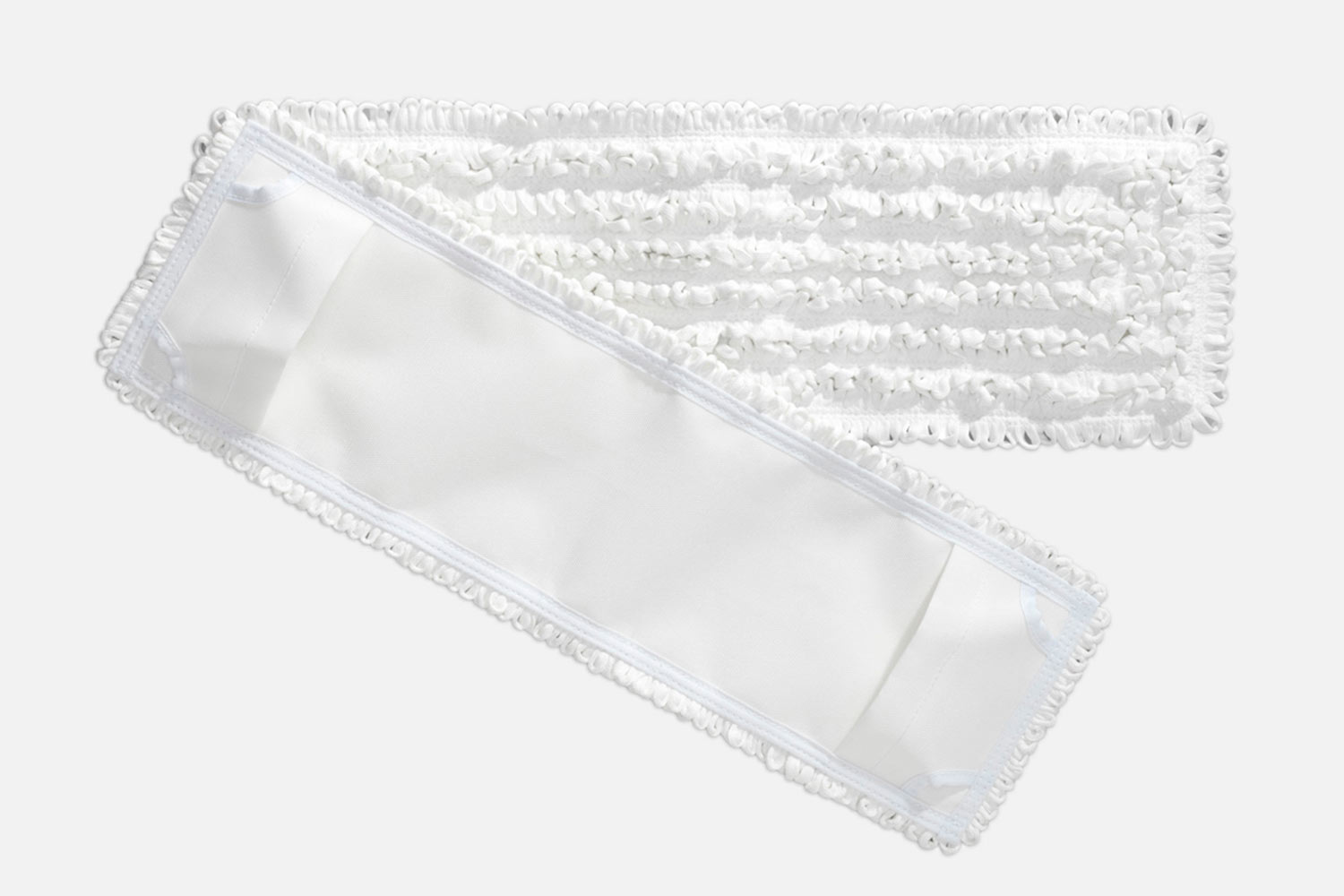
  • Cotton: High liquid absorption, but unsuitable due to high particle release.
  • Cellulose: High liquid absorption, but still too high particle release.
  • Polyester: Slightly lower liquid absorption, but also lower particle release and therefore the better choice.
  • Polyester microfiber: Combines the advantages of both systems and also has a very high cleaning performance.
comprei cleanroom mop PurMop-P40

Shape and processing

  • Fringed or spaghetti mop
    • Advantages:
      • Good surface wetting (disinfection)
      • Easy to handle
      • Absorbs a lot of liquid
    • Disadvantages:
      • Low cleaning effect
      • Not GMP-compliant (as no reproducible disinfection can be ensured)
      • High particle emission
  • Reusable flat mop
    • Advantages:
      • Better cleaning performance than a fringed or spaghetti mop
      • Sustainable through reuse
      • Area output controllable and reproducible
    • Disadvantages:
      • Wear difficult to control over the period of use, validation not possible
      • Risk of contamination carryover (are washed together with other cleaning textiles)
      • Contractual commitment and complex logistics
  • Disposable flat mop
    • Advantages:
      • Best cleaning performance in comparison
      • Absolute safety for every application (incl. certificates for every batch)
      • Cheaper than a reusable flat mop
      • Proven cleanroom suitability (GMP-compliant)
      • Low disinfectant consumption
      • Less packaging than reusable systems (up to 10 mops double-packed)
      • Lowest CO2 footprint (due to less transportation than reusable systems)
      • Flexibility and easy handling (gives safety important in the GMP area)
    • Disadvantages:
      • Slightly higher costs (can be reduced by subsequent use outside the cleanroom)
      • Disposal/waste topic
  • Mop wipes
    • Advantages:
      • Available pre-impregnated with various biocides
      • Ideal impregnation, easy handling

Summary

The selection of a suitable cleanroom mop has a significant influence on cleaning success, which is why this topic should be given the appropriate attention. Due to the large number of influencing factors and models, it is not possible to make a general statement about which mop should be used in your cleanroom. A coherent cleaning and disinfection concept makes it easier to define the right cleanroom mop. Modern textiles enable efficient and very good cleaning.

We will be happy to advise you on your choice and provide you with samples. Contact us for a non-binding consultation or sample request.

Advice / sample service

Learning solutions for the pharmaceutical industry, GMP

Clean room cuboid

Realistic simulations and visualizations of activities make invisible connections visible. Learners experience their own impact in the cleanroom right in the middle of the action. They experience in-depth sensitization that becomes firmly anchored.