Cleanroom paper
At first glance, paper and cleanrooms don't seem to be a love story. The paperless workplace is currently being discussed in many companies. In the cleanroom, however, it is a difficult undertaking to do without paper altogether.
In cleanroom operations, as in other HiTech manufacturing companies, there is a lively exchange of information. Information to employees, equipment manuals, personal notes, sketches and often also batch reports for the manufactured products - all this information is recorded and distributed on paper both internally and externally in the cleanroom.
Cellulose-containing materials, which include paper, release a considerable number of particles. For this reason alone, all alarm bells should ring when it comes to paper in the cleanroom. However, you do not have to do without manual documentation in the cleanroom if the quality is appropriate.
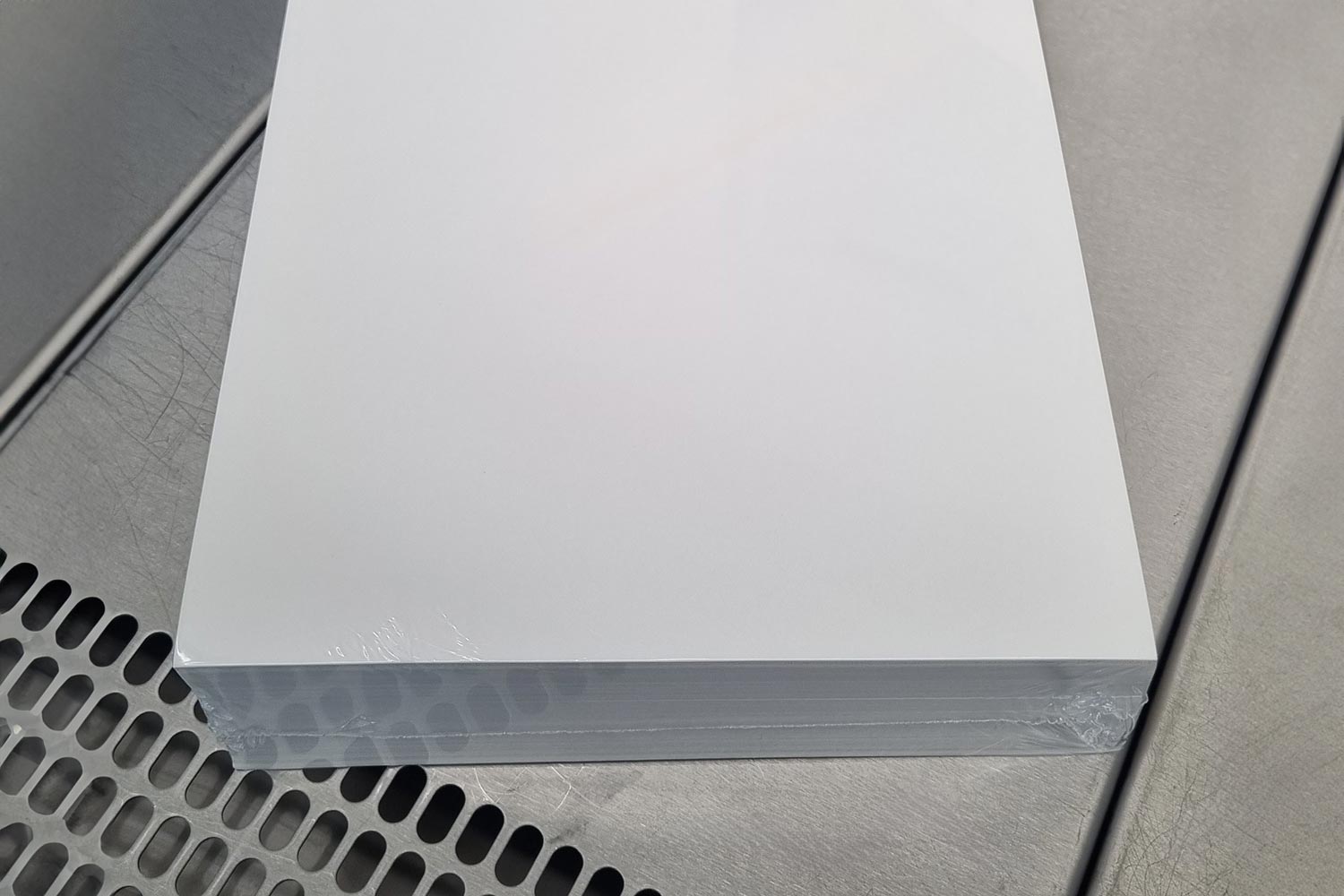
Our cleanroom paper offers you the following quality features:
- Abrasion resistance
- Tear and tear propagation resistance
- Low ion release
- Sterilizability
- Low particle scattering
This paper removes the cutting dust from the cut edges. It can also be copied, written on and printed on. The papers should have sufficient tear and tear propagation resistance so that the edge is not destroyed by tearing and particles are not released during handling. For the semiconductor industry, it is important that only small quantities of ions are released from cleanroom papers, as these can be detrimental to the production process.
Additional protection is provided by special surfaces that bind particles to the surface through a weak electrostatic charge. In contrast, conventional paper, which emits massive amounts of particles, is unsuitable for use in cleanrooms.
Due to these high quality criteria, cleanroom paper is also used to separate certain products from each other if they are not allowed to lie on top of each other before, during or after production, such as silicon wafers. Here, the clean paper is often used as a separator sheet to protect the critical product surfaces and to absorb mechanical shocks during transportation.